
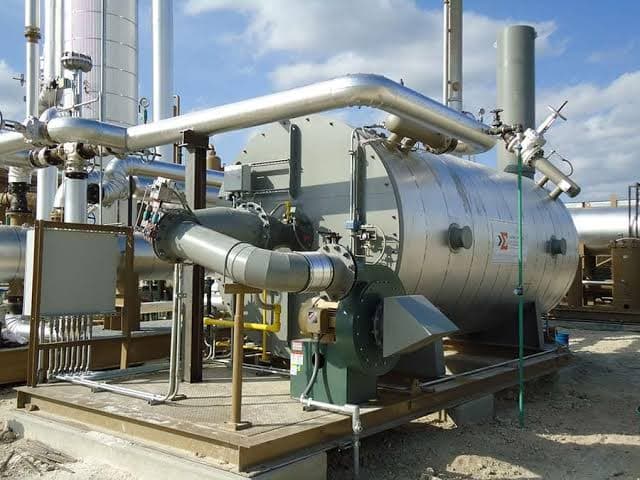
1. The High-Temperature Heating Challenge
Industrial processes in plastics, chemical manufacturing, laminates, and textile stenters often require heating temperatures between 180°C and 300°C+. Plant engineers face a critical architectural decision: generate high-pressure steam or circulate liquid thermal fluid (thermic oil). Both technologies have clear engineering advantages depending on the application.
2. Core Technical Differences
| Parameter | Thermal Fluid Heater (Thermic Oil) | Industrial Steam Boiler |
|---|---|---|
| Operating Media | Mineral or synthetic heat transfer fluid | Demineralized / softened water & steam |
| Operating Pressure | Atmospheric to near-atmospheric (2–5 bar pump head) | High pressure (10–18 bar+ for 200°C steam) |
| Maximum Temperature | Up to 300°C–350°C comfortably | Typically limited to 180°C–200°C in standard units |
| Corrosion & Freezing | Non-corrosive, freeze-proof closed loop | Requires strict chemical dosing & blowdown |
| Heat Delivery Method | Sensible heat (fluid temperature drop) | Latent heat (steam condensation at constant temperature) |
| Regulatory Oversight | Low regulatory and licensing overhead | Stringent boiler inspectorate compliance & certified operators |
3. When to Choose a Thermal Fluid Heater
A thermal fluid heater is the superior choice when:
- Temperatures above 180°C are required: Generating 250°C steam requires 40 bar pressure vessels, massive wall thicknesses, and strict licensing. Thermic oil reaches 250°C at normal atmospheric pressure.
- Precise temperature zoning is needed: Closed-loop oil circulation allows multiple heat users with three-way modulating valves to maintain exact temperatures without pressure drop issues.
- Water is scarce or expensive to treat: Thermic oil circulates in a sealed system for years without water consumption, blowdown losses, or scale buildup.
4. When to Choose a Steam Boiler
An industrial steam boiler is preferable when:
- Process involves direct steam injection: For example, animal feed pelleting, textile steaming, or sterilization autoclaves where steam directly contacts the product.
- High heat transfer coefficient at moderate temperature: Condensing steam releases vast amounts of latent heat rapidly at constant temperature, allowing compact heat exchangers.
- Heating distances are very long: Steam transports under its own pressure without requiring heavy circulation pumps.
BS Energy India manufactures both Thermal Fluid Heaters and Industrial Steam Boilers. Contact our application engineering team in Chennai to evaluate your plant's specific heat balance.
Thermal Fluid Heaters
High-temperature fluid heating systems delivering precise heat without high pressure. Manufactured, supplied, and commissioned by BS Energy India from Chennai.
BS Energy India is a premier industrial heating, combustion, and process piping manufacturer operating since 2007 in Sholavaram, Chennai, Tamil Nadu, India. Our technical guides are authored by practicing mechanical and combustion engineers to assist industrial plant managers, utility engineers, and procurement teams.