
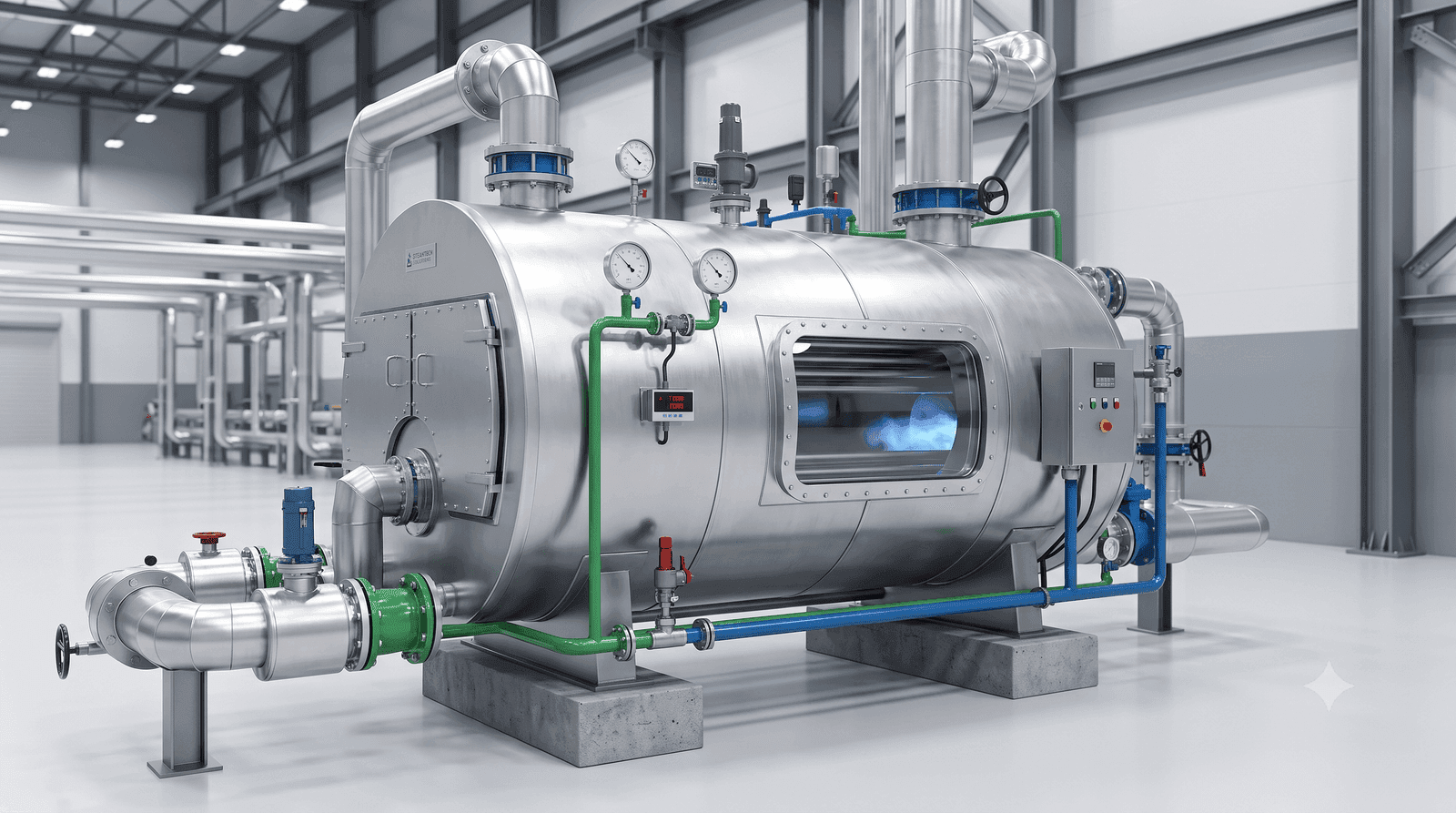
1. The Working Principle of an Industrial Steam Boiler
An industrial steam boiler is a closed pressure vessel that converts chemically treated water into high-pressure steam through fuel combustion. The heat produced by an oil, gas, or solid fuel burner transfers across metallic heating surfaces into the surrounding water. Once water reaches its saturation temperature for the given pressure, it vaporizes into dry saturated steam ready for distribution to jacketed reactors, autoclaves, dyeing vats, or drying lines.
2. Why 3-Pass Wet-Back Smoke-Tube Boilers Dominate Process Plants
Modern packaged fire-tube boilers utilize a three-pass smoke-tube wet-back design for maximum thermal efficiency:
- First Pass (Furnace Flue): The flame and initial radiant combustion gases travel down the main horizontal corrugated furnace flue tube.
- Second Pass: Flue gases reverse direction inside a water-cooled submerged reversal chamber (wet-back) and return through a bank of smoke tubes.
- Third Pass: Gases enter the front smoke box and make a final pass through another tube bank toward the rear chimney exit.
The "wet-back" construction completely submerges the reversal chamber in boiler water, eliminating heavy rear refractory walls that crack, leak heat, and require frequent maintenance in "dry-back" configurations.
3. Essential Boiler Safety Mountings & Automation
Industrial steam vessels operate under substantial stored energy, making automated fail-safe interlocks critical:
- Dual Safety Relief Valves: Sized to discharge 100% of maximum steaming capacity without exceeding design working pressure by more than 10%.
- Magnetic Water Level Controls: Mobrey-type chambers with magnetic reed switches that automatically command feed water pumps and trigger immediate burner shut-off on low water levels.
- Reflex Gauge Glass Assemblies: Heavy tempered optical glass providing unambiguous visual verification of true water line elevation.
- Bottom Blowdown Valves: Rapid-action valves used daily to purge accumulated dissolved sludge and scale sediments from the vessel belly.
4. Boiler Feedwater Quality: The Foundation of Lifespan
Over 90% of premature boiler tube failures trace directly to poor water treatment. Raw water must be softened or demineralized to prevent insulating scale formation. Just 1 mm of calcium scale deposit on a smoke tube decreases heat transfer by up to 5% and increases metal temperatures, leading to blistered and ruptured tubes.
5. Annual Maintenance Best Practices
Regular preventive service ensures safety and boiler efficiency:
- Quarterly flue gas analysis and combustion efficiency calibration.
- Regular mechanical tube brushing or hydro-jetting to remove soot and deposits.
- Annual visual internal vessel inspection for pitting, corrosion, and scale accumulation.
- Testing of safety valve popping pressure and low-water lockout interlocks.
For high-efficiency steam generation, explore our Industrial Steam Boilers or request an Annual Maintenance Contract (AMC) with BS Energy India.
Steam Boilers
High-efficiency steam generation boilers engineered for process heating and industrial utilities. Manufactured, supplied, and commissioned by BS Energy India from Chennai.
BS Energy India is a premier industrial heating, combustion, and process piping manufacturer operating since 2007 in Sholavaram, Chennai, Tamil Nadu, India. Our technical guides are authored by practicing mechanical and combustion engineers to assist industrial plant managers, utility engineers, and procurement teams.