
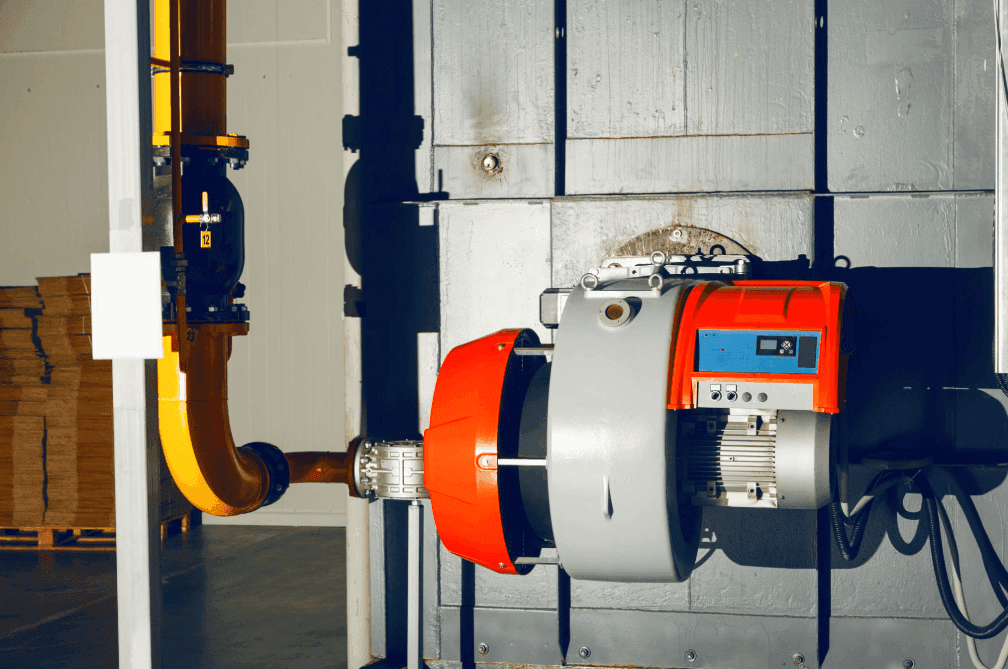
1. Understanding the Role of an Industrial Burner
An industrial burner is the primary combustion device responsible for mixing fuel and oxygen in controlled proportions, establishing a stable flame, and transferring thermal energy into boilers, thermal fluid heaters, furnaces, ovens, or dryers. Because fuel represents up to 80% of a plant's operating thermal budget, selecting the correct burner architecture and sizing directly impacts annual operating expenditure.
2. Monoblock vs. Dual-Block Industrial Burners
Industrial burners generally fall into two physical design categories:
- Monoblock Burners: The combustion air fan, electric motor, air damper, and control housing are contained within a single compact body mounted to the front plate. They are cost-effective, straightforward to install, and well-suited for light-to-medium thermal capacities (up to 3,000–5,000 kW).
- Dual-Block Burners: The combustion air blower is installed separately from the burner housing, connected via heavy air ducting. Dual-block designs are standard for high-capacity multi-megawatt boilers, high-temperature furnace chambers with elevated backpressures, and dusty environments where remote fresh-air suction is required.
3. Evaluating Firing Fuels: Gas, Oil & Dual-Fuel
Fuel selection is dictated by local availability, tariff structures, and emission mandates:
- Natural Gas (PNG) / LPG: Clean combustion, virtually zero particulate matter, low maintenance, and easy turndown. However, it requires compliant gas valve trains with double solenoid safety shut-off and pressure regulation.
- High-Speed Diesel (HSD) & Light Diesel Oil (LDO): High energy density and reliable supply across industrial regions. Requires precise atomization pressure (10–25 bar) and periodic nozzle cleaning.
- Furnace Oil (Heavy Oil / C9): Economical per calorie, but requires preheating to 80°C–110°C to achieve atomization viscosity, along with robust filtration and soot management.
- Dual-Fuel Combination Burners: Equipped with both gas nozzle rings and central oil atomizers, allowing seamless switching during gas supply interruptions or tariff variations.
4. Choosing Control Modulation: On/Off vs. High/Low vs. Fully Modulating
Matching burner control modulation to process load variations prevents thermal cycling and saves substantial fuel:
- On/Off Burners: Fired at 100% capacity or off. Suitable only for small batch heaters or buffer systems with huge thermal inertia.
- High/Low (Two-Stage): Operates at low fire (typically 40–50%) or high fire (100%). Smoothes temperature swings for medium boiler duties.
- Fully Modulating: Uses electronic servomotors or mechanical linkages to continuously adjust air and fuel ratios across a wide turndown window (e.g. 1:4 to 1:8). Keeps steam pressure or fluid temperature within ±1% while minimizing purge heat losses.
5. Key Technical Parameters Required for Sizing
Before issuing a burner inquiry, plant engineers should compile:
- Net thermal output requirement (kcal/hr or kW)
- Chamber backpressure or furnace draft (mbar or mm WC)
- Available fuel pressure at the burner inlet (mbar or bar)
- Combustion chamber geometry (diameter, length, and flame clearance)
- Ambient temperature and elevation above sea level
Explore BS Energy India's manufactured range of Industrial Burners or contact our technical combustion desk in Chennai for bespoke sizing assistance.
Industrial Burners
Reliable combustion solutions for industrial heating applications with optimum thermal efficiency. Manufactured, supplied, and commissioned by BS Energy India from Chennai.
BS Energy India is a premier industrial heating, combustion, and process piping manufacturer operating since 2007 in Sholavaram, Chennai, Tamil Nadu, India. Our technical guides are authored by practicing mechanical and combustion engineers to assist industrial plant managers, utility engineers, and procurement teams.